Recording
- Recording
- David Wales
- Length
- 4 h 4 min
- Language
- English
- Source
- LibriVox
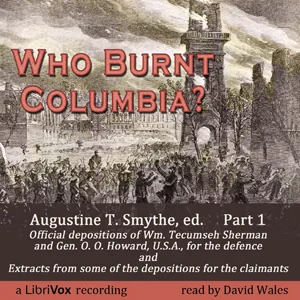
David Wales · 4 h 4 min
This LibriVox reading consists of selections from depositions in a lawsuit brought after the end of the American Civil War by some businessmen of the former Confederacy. This reading focuses on the sworn statements of General…

No monthly subscription Volunteer narrators may make several recordings of the same work. Compare the narrator and runtime to choose your edition.
Your review helps other listeners choose: every published comment earns 10 points, a rating without text 2, and every “Helpful” you receive 5. Your rank shows next to your name.
Log in to save your private ratings and notes.
Who Burnt Columbia?
Keep your thoughts about the book. Only you can see your ratings and notes.
David Wales
Keep your thoughts about the recording. Only you can see your ratings and notes.
This LibriVox reading consists of selections from depositions in a lawsuit brought after the end of the American Civil War by some businessmen of the former Confederacy. This reading focuses on the sworn statements of General William Tecumseh Sherman who commanded the Carolinas campaign and General Oliver O. Howard who was one of Sherman’s subordinate commanders. The subject is the still-controversial burning of Columbia, capital of South Carolina, toward the end of the Civil War.
“Official Depositions of Wm, Tecumseh Sherman, “General of the Army of the United States,” and Gen. O.O. Howard, U.S.A., For The Defence; and Extracts From Some Of The Depositions For The Claimants, Filed in Certain Claims vs. United States, Pending Before “The Mixed Commission on British and American Claims,” in Washington, D.C.” (Book subtitle)
The Carolinas Campaign was the final campaign in the Western Theater of the American Civil War. In January 1865, Union Maj. Gen. William Tecumseh Sherman advanced north from Savannah, Georgia, through the Carolinas, with the intention of linking up with Union forces in Virginia…. [After conquering Atlanta, Sherman] persuaded Grant that he should march north through the Carolinas… destroying everything of military value along the way, similar to his march to the sea through Georgia. Sherman was particularly interested in targeting South Carolina, the first state to secede from the Union, for the effect it would have on Southern morale…. On February 17, Columbia surrendered to Sherman... Union forces were overwhelmed by throngs of liberated Federal prisoners and emancipated African Americans. Many soldiers took advantage of ample supplies of liquor in the city and began to drink. Fires began in the city, and high winds spread the flames across a wide area. Most of the central city was destroyed, and the city's fire companies found it difficult to operate in conjunction with the invading Union army, many of whom were also trying to put out the fire. The burning of Columbia has engendered controversy ever since, with some claiming the fires were accidental, others stating they were a deliberate act of vengeance, and others claiming that the fires were set by retreating Confederate soldiers who lit bales of cotton on their way out of town… On February 18, Sherman's forces destroyed virtually anything of military value in Columbia, including railroad depots, warehouses, arsenals, and machine shops.
- Summary by Book’s subtitle, Wikipedia, and David Wales
Also narrated by David Wales.

Also narrated by David Wales.

Shared category: War & Military.

Shared category: War & Military.
A selection based on your preferences.
Based on the books and topics that interest you.
Compare the selected recording on LibriVox. Check the access type and terms for each offer.
Compare ways to listenThe selected recording is available on LibriVox for free, without a trial subscription.
View platform termsFree access is available on LibriVox. Compare buying the audiobook with the subscription periods you would need. You can include your existing subscriptions in the comparison.
How we compare access and priceThe selected recording is narrated by David Wales. The runtime at normal speed is 4 h 4 min. Runtime can vary by narrator, translation and edition. Compare prices for the same recording.
Yes. The selected recording (4 h 4 min) is on LibriVox: free to listen. Check the terms on the platform before you choose.
Compare ways to listenThis recording is in English.
This page compares audiobooks and does not provide a PDF. Look for an authorized digital edition through the publisher, a library or a bookstore.
That depends on the platform and plan. An in-app download is not necessarily an MP3 file. Check offline playback for your device and whether access continues after a subscription ends.