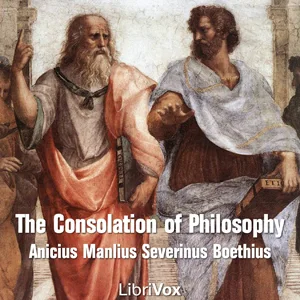
Recording
- Recording
- InTheDesert
- Length
- 1 h 41 min
- Language
- English
- Source
- LibriVox

InTheDesert · 1 h 41 min
It was in the last dozen years of his life that Boethius wrote on a vastly different topic, or what one might imagine a vastly different topic, namely, theology. There are preserved under his name four brief but pithy letters,…

No monthly subscription Volunteer narrators may make several recordings of the same work. Compare the narrator and runtime to choose your edition.
Your review helps other listeners choose: every published comment earns 10 points, a rating without text 2, and every “Helpful” you receive 5. Your rank shows next to your name.
Log in to save your private ratings and notes.
The Theological Tractates
Keep your thoughts about the book. Only you can see your ratings and notes.
InTheDesert
Keep your thoughts about the recording. Only you can see your ratings and notes.
It was in the last dozen years of his life that Boethius wrote on a vastly different topic, or what one might imagine a vastly different topic, namely, theology. There are preserved under his name four brief but pithy letters, addressed, one to Symmachus and the rest to a mutual friend, John the Deacon, dealing with theological subjects of great contemporary importance. That to Symmachus is entitled "How that the Trinity is one God and not three Gods", and presents a specially vigorous criticism of the Arian heresy. Number 2, addressed to John, continues this topic; it is entitled, "Whether Father, Son, and Holy Spirit may be substantially predicated of Divinity". The last in the series, "A Treatise against Eutyches and Nestorius", takes up one of the great controversies of the age, the doctrine of the Person of Christ. Boethius upholds the orthodox view against the divergent heresies of Eutyches, who discarded the human element in our Lord’s nature, and of Nestorius, who discarded the divine element. The little work, which was written most probably in 512, is one of the best contributions to the subject ever made. The definitions of nature and of person given by the author became classical and were constantly appealed to by the Schoolmen; “Nature,” according to Boethius, is the specific difference that gives form to anything; “Person” is the individual substance of a rational nature.
The philosopher is also evident in the title of the third letter “How Substantives can be good in virtue of their existence without being Absolute Goods”. If this piece had been separately transmitted as the work of the author of the Consolation of Philosophy and the other theological tractates had been all lost, nobody would have thought of questioning the authorship. As it is, it is part and parcel of this little collection, the genuineness of which has the best possible attestation in the manuscripts. To anybody who has read through, or read in sufficient extracts, Boethius’s works on logic, the theological tractates seem altogether of a piece. It is the same mind here as there, only exercising itself in a different field, with the result that Boethius has started a new method in theology, the application of Aristotelian logic to Christian problems. - Summary adapted from E.K. Rand
Shared category: Christianity - Other.
Shared category: Christianity - Other.

Shared category: Christianity - Other.

Shared category: Christianity - Other.
A selection based on your preferences.
Based on the books and topics that interest you.
Compare the selected recording on LibriVox. Check the access type and terms for each offer.
Compare ways to listenThe selected recording is available on LibriVox for free, without a trial subscription.
View platform termsFree access is available on LibriVox. Compare buying the audiobook with the subscription periods you would need. You can include your existing subscriptions in the comparison.
How we compare access and priceThe selected recording is narrated by InTheDesert. The runtime at normal speed is 1 h 41 min. Runtime can vary by narrator, translation and edition. Compare prices for the same recording.
Yes. The selected recording (1 h 41 min) is on LibriVox: free to listen. Check the terms on the platform before you choose.
Compare ways to listenThis recording is in English.
This page compares audiobooks and does not provide a PDF. Look for an authorized digital edition through the publisher, a library or a bookstore.
That depends on the platform and plan. An in-app download is not necessarily an MP3 file. Check offline playback for your device and whether access continues after a subscription ends.