Recording
- Recording
- LivelyHive
- Length
- 8 h 5 min
- Language
- English
- Source
- LibriVox
LivelyHive · 8 h 5 min
Joseph Priestley, FRS was an 18th-century English theologian, Dissenting clergyman, natural philosopher, chemist, educator, and political theorist who published over 150 works. In “Experiments and Observations on Different Kinds…

No monthly subscription Volunteer narrators may make several recordings of the same work. Compare the narrator and runtime to choose your edition.
Your review helps other listeners choose: every published comment earns 10 points, a rating without text 2, and every “Helpful” you receive 5. Your rank shows next to your name.
Log in to save your private ratings and notes.
Experiments and Observations on Different Kinds of Air
Keep your thoughts about the book. Only you can see your ratings and notes.
LivelyHive
Keep your thoughts about the recording. Only you can see your ratings and notes.
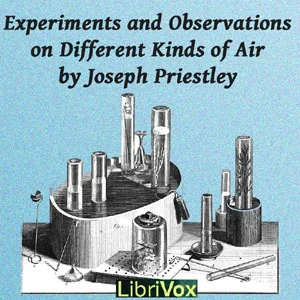
Joseph Priestley, FRS was an 18th-century English theologian, Dissenting clergyman, natural philosopher, chemist, educator, and political theorist who published over 150 works. In “Experiments and Observations on Different Kinds of Air,” he reviews experiments with gases. A common theme in this work is measuring the volumes of gases held in glass tubes, and their increase or decrease when exposed to other substances. He also tests the effects of gases on mice, plants and insects.
Priestley demonstrated that fixed air (now known as CO2) can be produced from several reactions including alcoholic fermentation, combustion and a mixture of oil of vitriol and chalk (sulfuric acid and calcium oxide). He also showed that it is soluble in water, and that its toxic effects can be reduced when agitated in water. In other experiments, he showed that combinations of gases can mix to form a smaller volume than the sum of both separate gases, as when he combined common air (atmospheric air) with nitrous air (nitric oxide, NO).
For some experiments, Priestley tests whether the properties of gases change when stored. He finds that inflammable air (hydrogen, H2 or a mixture of hydrocarbons) becomes less flammable but retains its toxic properties.
Also interested in electricity, Priestley tests the effects of gases on sparks. While he finds that gases are generally good insulators, he also finds that some gases change the colors of electric sparks. He also discovers that some mixtures of air explode in their entirety, while others must be combined with common air in order to burn.
Priestley uses several terms common to the study of natural philosophy, or chemical experiments as known today. Some of the terms are parts of obsolete theories or are old names for chemicals now given standard names. To better understand Priestley's observations, the following terms are defined according to their present names. here
A selection based on your preferences.
Based on the books and topics that interest you.
Compare the selected recording on LibriVox. Check the access type and terms for each offer.
Compare ways to listenThe selected recording is available on LibriVox for free, without a trial subscription.
View platform termsFree access is available on LibriVox. Compare buying the audiobook with the subscription periods you would need. You can include your existing subscriptions in the comparison.
How we compare access and priceThe selected recording is narrated by LivelyHive. The runtime at normal speed is 8 h 5 min. Runtime can vary by narrator, translation and edition. Compare prices for the same recording.
Yes. The selected recording (8 h 5 min) is on LibriVox: free to listen. Check the terms on the platform before you choose.
Compare ways to listenThis recording is in English.
This page compares audiobooks and does not provide a PDF. Look for an authorized digital edition through the publisher, a library or a bookstore.
That depends on the platform and plan. An in-app download is not necessarily an MP3 file. Check offline playback for your device and whether access continues after a subscription ends.