Recording
- Recording
- InTheDesert
- Length
- 7 h 29 min
- Language
- English
- Source
- LibriVox
InTheDesert · 7 h 29 min
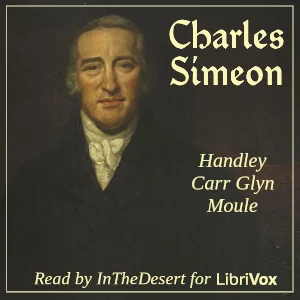
Charles Simeon had come up to King’s college from Eton, a wild undergraduate, famous for his love of horses and extravagance in dress; but one day he discovered that the rules of the college compelled him to receive the Communion…

No monthly subscription Volunteer narrators may make several recordings of the same work. Compare the narrator and runtime to choose your edition.
Your review helps other listeners choose: every published comment earns 10 points, a rating without text 2, and every “Helpful” you receive 5. Your rank shows next to your name.
Log in to save your private ratings and notes.
Charles Simeon
Keep your thoughts about the book. Only you can see your ratings and notes.
InTheDesert
Keep your thoughts about the recording. Only you can see your ratings and notes.
Charles Simeon had come up to King’s college from Eton, a wild undergraduate, famous for his love of horses and extravagance in dress; but one day he discovered that the rules of the college compelled him to receive the Communion on the following Sunday. He had lived in an utterly careless home, but he knew enough of religion to realise that attendance at the Lord’s Table was a serious thing, which should not be undertaken without some preparation. Not quite knowing what to do, he went to a bookseller’s shop, and bought a copy of Bishop Wilson on the Lord’s Supper, and learned from it for the first time the meaning of the Atonement. This was the turning point in his life. Henceforth all his energy was concentrated in a single channel. His one ambition was to make all Cambridge grasp this doctrine too.
He became Fellow of his college, and then took Holy Orders, and was appointed (1783) Minister of Trinity Church, in the Market Place. Here he learnt what it meant to be known as an Evangelical. The seat-holders deserted the church in a body, and locked the great doors of the pews, so that no one else should use them. When Simeon placed forms in the aisles, the churchwardens threw them out into the churchyard, and for more than ten years his congregation had to stand. Rowdy bands of under graduates used to try to break up the service. “For many years,” wrote one of his contemporaries, “Trinity Church and the streets leading to it were the scenes of the most disgraceful tumults. In vain did Simeon exert himself to preserve order. In vain did Parish, who was popular with the under graduates, station himself outside the door to prevent improper conduct; though one undergraduate, who had been apprehended by Simeon, was compelled to read a public apology, the disturbances still continued.” “Those who worshipped at Trinity,” wrote another, “were supposed to have left common sense, discretion, sobriety, attachment to the Established Church, love of the liturgy, and whatever else is true and of good report, in the vestibule.”
But Simeon went on with his work with quiet pertinacity, never deliberately doing anything to provoke opposition, but never flinching from declaring what he knew to be the truth, and won first toleration, and then recognition as the most inspiring teacher in Cambridge. Trinity Church was always crowded with undergraduates. His Friday Conversation Circle for the discussion of religious questions, his Bible Class and Doctrine Class never failed to fill his room at King’s with eager young disciples, and especially his famous Sermon Class, in which most of the Evangelical preachers of the next generation were trained. And this continued for fifty years with results which no man can estimate. A teacher so wise, so genial, so spiritual, moulding the lives of the men from whom the bulk of the clergy were drawn, acquired a position almost unique in the English Church. “If you knew what his authority and influence were,” wrote Lord Macaulay, who was himself at Cambridge in Simeon’s later days, “and how they extended from Cambridge to the most remote corners of England, you would allow that his real sway in the Church was far greater than that of any Primate.” Down to comparatively modern times in undergraduate slang an earnest Christian was always called a “Sim”.
- Summary from "A History of the Evangelical Party in the Church of England" by GR Balleine
Shared category: Christianity - Biographies.
Shared category: Christianity - Biographies.
Shared category: Christianity - Biographies.
Shared category: Christianity - Biographies.
A selection based on your preferences.
Based on the books and topics that interest you.
Compare the selected recording on LibriVox. Check the access type and terms for each offer.
Compare ways to listenThe selected recording is available on LibriVox for free, without a trial subscription.
View platform termsFree access is available on LibriVox. Compare buying the audiobook with the subscription periods you would need. You can include your existing subscriptions in the comparison.
How we compare access and priceThe selected recording is narrated by InTheDesert. The runtime at normal speed is 7 h 29 min. Runtime can vary by narrator, translation and edition. Compare prices for the same recording.
Yes. The selected recording (7 h 29 min) is on LibriVox: free to listen. Check the terms on the platform before you choose.
Compare ways to listenThis recording is in English.
This page compares audiobooks and does not provide a PDF. Look for an authorized digital edition through the publisher, a library or a bookstore.
That depends on the platform and plan. An in-app download is not necessarily an MP3 file. Check offline playback for your device and whether access continues after a subscription ends.