Recording
- Recording
- Leonard Wilson (1930-2024)
- Length
- 1 h 52 min
- Language
- English
- Source
- LibriVox
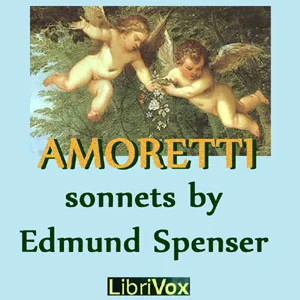
Leonard Wilson (1930-2024) · 1 h 52 min
The Amoretti (meaning little love poems) is a sequence of 89 sonnets written in the tradition of the Petrarchan sonnets, a popular form for poets of the Renaissance period. Spenser’s sequence has been largely neglected in modern…

No monthly subscription Volunteer narrators may make several recordings of the same work. Compare the narrator and runtime to choose your edition.
Your review helps other listeners choose: every published comment earns 10 points, a rating without text 2, and every “Helpful” you receive 5. Your rank shows next to your name.
Log in to save your private ratings and notes.
Amoretti: A sonnet sequence
Keep your thoughts about the book. Only you can see your ratings and notes.
Leonard Wilson (1930-2024)
Keep your thoughts about the recording. Only you can see your ratings and notes.
The Amoretti (meaning little love poems) is a sequence of 89 sonnets written in the tradition of the Petrarchan sonnets, a popular form for poets of the Renaissance period. Spenser’s sequence has been largely neglected in modern times, while those of his contemporaries William Shakespeare and Sir Philip Sidney have been acclaimed. However, because of the artistic skill, along with the emotion and the humor exhibited, these poems deserve a broader hearing, even though they may be somewhat difficult for the present-day reader, partly through Spenser’s love for words and expressions that were already archaic in his time.
Amoretti, written throughout the year 1594 and published the following year, violates at least one of the conventional elements of the Renaissance sonnet sequences. Other poets, including Petrarch and Sidney, chose as the inspiration for their sonnets a woman who was inaccessible to the poet, sometimes even married to someone else. They idealized this woman, seeming to be extravagantly suffering because of their passionate admiration, while in real life they might hardly know the lady and had no real interest in an actual love affair. Spenser, however, dedicated his verses to a woman that he actually loved and sought, Elizabeth Boyle, whom he then married.
Also the sonnet series by other poets were usually despairing of any fruition in regard to the lady, and Spenser certainly does show much frustration himself in his efforts to achieve a closer relationship with his love; but as the series progresses, he gradually sees improvement in the success of his wooing, as his actual wedding nears. The poems feature elaborate imagery, loaded with metaphorical situations, saying much the same thing repeatedly in a wide variety of ways, with much clever creativity, sometimes impressive and sometimes a bit awkward. There is a rich vein of humor running through the whole sequence, often through mock passion, and there is even a bit of sensuality in some of the later sonnets. The better poems are often sharp and crystalline, sparkling in their freshness and originality. (Introduction by Leonard Wilson)
A selection based on your preferences.
Based on the books and topics that interest you.
Compare the selected recording on LibriVox. Check the access type and terms for each offer.
Compare ways to listenThe selected recording is available on LibriVox for free, without a trial subscription.
View platform termsFree access is available on LibriVox. Compare buying the audiobook with the subscription periods you would need. You can include your existing subscriptions in the comparison.
How we compare access and priceThe selected recording is narrated by Leonard Wilson (1930-2024). The runtime at normal speed is 1 h 52 min. Runtime can vary by narrator, translation and edition. Compare prices for the same recording.
Yes. The selected recording (1 h 52 min) is on LibriVox: free to listen. Check the terms on the platform before you choose.
Compare ways to listenThis recording is in English.
This page compares audiobooks and does not provide a PDF. Look for an authorized digital edition through the publisher, a library or a bookstore.
That depends on the platform and plan. An in-app download is not necessarily an MP3 file. Check offline playback for your device and whether access continues after a subscription ends.